
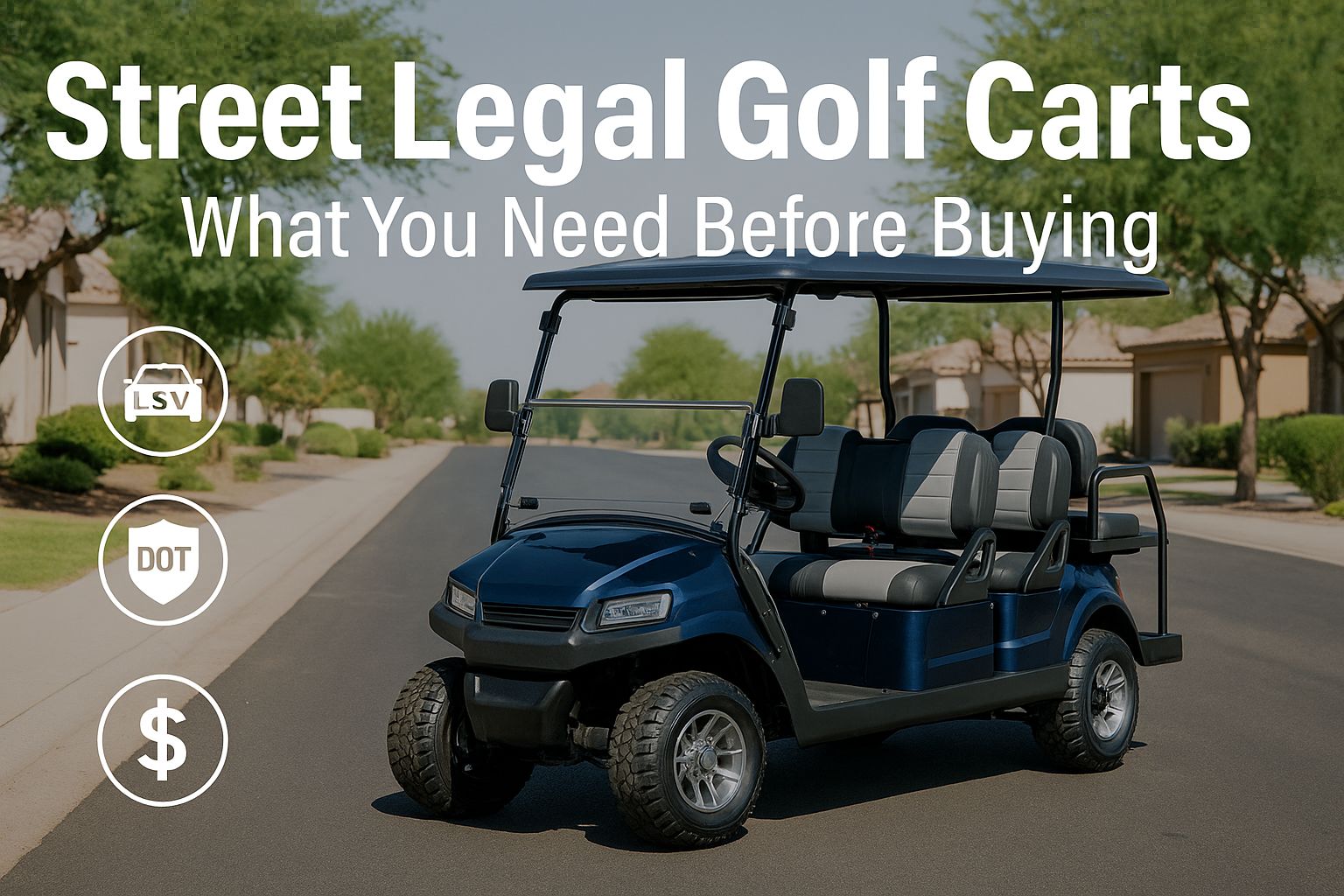
It’s the dream, isn’t it? You’re not just buying a “golf cart”; you’re buying a new lifestyle. You’re imagining a warm evening, cruising silently through your neighborhood, heading to a local restaurant, or taking the kids to the community pool. You’re picturing a “Life Cart”—a true second vehicle for your community.
But then, you run into the single most confusing, most dangerous, and most misunderstood topic in the entire industry: making it legal for the road.
You’ve heard the terms thrown around. You’ve seen a neighbor’s “lifted” cart with some headlights, and he says it’s “street legal.” You’ve seen dealers selling “street legal kits.” And then you see official-looking vehicles with license plates that are called “LSVs.”
What’s the difference? Is there any difference?
Let us be your expert guide. As a premier dealer, our reputation is built on safety, transparency, and the long-term satisfaction of our customers. And we are here to tell you that the difference between a “street legal” kit and a “factory-built LSV” is the most important decision you will make.
This is not just “semantics.” It is the difference between:
- A Safe, Insurable Vehicle vs. A Dangerous, Uninsurable Liability
- A Federally-Compliant “Car” vs. A “Toy” with a Patchwork Kit
- Total Peace of Mind vs. A Constant Legal “Gray Area”
This guide will deconstruct the “street legal golf cart vs LSV” debate. We will define “what is an LSV golf cart” by federal standards. And we will show you why a factory-built “Evolution street legal” model is the only smart, safe, and future-proof choice for your family.
Part 1: The “DIY” Danger — Deconstructing the “Street Legal Kit”
This is the “Old Way,” and it’s a model built on risk.
For decades, the only option was to buy a basic “fleet cart” (a cart designed for a golf course) and “make it legal” by bolting on an aftermarket “street legal kit.”
What is a “Street Legal Kit?” A “kit” is a box of parts, usually ordered online or installed by a dealer, that includes the bare minimum of components:
- A set of basic headlights and taillights
- A horn (often a simple button)
- A couple of strap-on or bolt-on side mirrors
- A “slow-moving vehicle” (SMV) triangle
- A basic, cheap acrylic (plastic) folding windshield
This “solution” is filled with massive, dangerous, and expensive gaps.
Risk 1: It’s a “Toy,” Not a “Vehicle” (The 17-Digit VIN Problem)
This is the single most important takeaway. A cart with a “kit” is still, in the eyes of the law, a “golf cart.” It was not manufactured to be a motor vehicle. It does not have a 17-digit Vehicle Identification Number (VIN) that identifies it as a “Low-Speed Vehicle.”
Why does this matter? Because you cannot register or get insurance for it as a “motor vehicle.” You are trying to insure a “toy.” In the absolute best-case scenario, your insurance policy is a confusing “add-on” to your homeowner’s policy.
Now, imagine this nightmare scenario: You are in an accident. You get hurt, or worse, someone else does. Your insurance company will investigate. The moment they discover you were operating a “golf cart” (a vehicle not designed for the road) on a public street, they will deny your claim.
You are now 100% personally and financially liable for all the property damage, all the medical bills, and all the ensuing lawsuits. That “kit” didn’t make you “legal”; it just gave you a false sense of security while you exposed your family to financial ruin.
Risk 2: Inferior (and Unsafe) Components
The “kit” model is a race to the bottom on price. The components are cheap and unsafe.
- The Windshield: A kit’s “DOT-approved” windshield is almost always just stamped plastic (acrylic). An AS1 laminated glass windshield (like a car’s) is designed to be shatter-proof. An acrylic windshield will shatter into dangerous, sharp shards in an accident.
- The Brakes: This is the most terrifying part. A “kitted” cart still has the original brakes: 2-wheel (rear only) mechanical drum brakes. This is a thin bicycle-style cable that pulls on two small brake shoes only in the back. It’s weak, needs constant adjustment, and is notoriously unreliable when wet. It was designed to stop a 12 MPH cart on grass. It was not designed to stop a 1,000-lb cart with 4 people from 25 MPH on a paved road.
- The Seatbelts: A “kit” will include basic lap belts that you bolt… where, exactly? To the plastic body? To a thin piece of the frame? They are not factory-anchored or crash-tested.
Risk 3: The “Patchwork” of Local Laws
A “street legal kit” does not make your cart federally legal. It just means you are now at the mercy of a confusing patchwork of city ordinances, county rules, and HOA regulations.
Your kit might be “legal” in your 25 MPH gated community. But the moment you cross onto that 30 MPH public road to get to the grocery store, you are in a different jurisdiction. A police officer can (and will) pull you over, give you a massive ticket, and possibly even impound your vehicle.
The “street legal kit” is a gray-area, uninsurable, and unsafe “solution.” It’s the wrong way to buy.
Part 2: The “Federal Standard” — What is an LSV Golf Cart?
Now, let’s talk about the right way. The “real” way.
The term you need to know is LSV (Low-Speed Vehicle).
An LSV is NOT a “golf cart.” It is a specific, federally-defined vehicle class, just like a “car,” “truck,” or “motorcycle.”
The National Highway Traffic Safety Administration (NHTSA) defines an LSV in Federal Motor Vehicle Safety Standard No. 500 (FMVSS 500). This is the “rulebook” that separates a real vehicle from a toy.
To be a legal LSV, a vehicle must be manufactured to meet all of these standards from the factory. It’s not a “kit” you add later.
Here is what an LSV golf cart is, by law:
- It MUST have a 17-digit VIN. This is the “golden ticket.” This number proves it was manufactured as an LSV. It’s what allows you to get a title, a registration, a license plate, and, most importantly, a real automotive insurance policy.
- It MUST be speed-limited to 20-25 MPH. It cannot go faster than 25 MPH.
- It MUST have 3-Point Seatbelts (automotive-style, over-the-shoulder) at every seating position.
- It MUST have a DOT-approved AS1 or AS4 Laminated Glass Windshield. (No plastic/acrylic).
- It MUST have a full lighting system: Headlights, taillights, brake lights, and turn signals.
- It MUST have Reflectors on all four corners of the vehicle.
- It MUST have Side Mirrors and a Rearview Mirror.
- It MUST have a Horn.
- It MUST have 4-Wheel Brakes. This is a critical safety rule.
When you buy a vehicle that meets these standards from the factory, you are buying a true vehicle.
- It’s Insurable: You can call your insurance agent and get a real auto policy. You are covered.
- It’s Legal: It’s federally recognized. It is legal to drive on any public road with a posted speed limit of 35 MPH or less (or as your state/local laws dictate). No more “patchwork” or gray areas.
- It’s Safe: It was engineered with safety in mind, from the frame-anchored seatbelts to the 4-wheel hydraulic brakes.
The street legal golf cart vs LSV debate is over: a “kit” is a risk. An “LSV” is a vehicle.
Part 3: The “Evolution Street Legal” Advantage: Safety & Luxury as Standard
This is where Evolution golf carts have completely changed the game.
For years, even the “big three” brands treated LSV status as an expensive, optional “package.” You’d buy their base cart, and then pay thousands extra for the “LSV Package,” which added the bare-minimum required parts.
Evolution’s philosophy is different. They looked at the modern “Life Cart” buyer and decided that safety and legality should not be an “option.”
They built their entire D5 and D-Max lineup to the LSV standard from the factory. The “Evolution street legal” cart is an LSV, and all the “luxury” features that make it an LSV are included as standard.
This is the “Evolution Advantage.” They didn’t just bolt on a kit; they integrated the technology.
1. Standard: The 17-Digit VIN and 4-Wheel Brakes
Every Evolution D5 Ranger, D5 Maverick, and D-Max rolls out of the factory with a 17-digit VIN. It is, by definition, a “Low-Speed Vehicle.”
More importantly, they didn’t just meet the “4-wheel brake” rule; they exceeded it. The standard braking system on these carts is 4-wheel hydraulic disc brakes. This is not a cheap mechanical drum. This is a sealed, automotive-grade system that provides incredible, reliable stopping power in all weather conditions.
2. Standard: A “Cocoon” of Safety
Look at the list of LSV requirements again. Now, look at the standard feature list for an Evolution. They are one and the same.
- Standard 3-Point Seatbelts: Anchored directly to the steel frame for real protection.
- Standard DOT Laminated Glass Windshield: No cheap, scratch-prone plastic.
- Standard Powered Side Mirrors with Turn Signals: Evolution didn’t just add “mirrors.” They added premium, car-like powered mirrors with the turn signal indicators built right in.
- Standard LED Lighting: Bright, “angel-eye” headlights, taillights, and self-canceling turn signals are all standard.
- Standard Backup Camera: Evolution exceeds the LSV standard by including a backup camera, integrated directly into the standard 9-inch touchscreen, to eliminate the rear blind spot.
3. Standard: The “Future-Proof” Platform
This is what makes the Evolution street legal model so brilliant. They combined the safety of an LSV with the technology of a luxury car.
The “old way” was to buy a $12,000 cart, add a $1,500 LSV kit, and a $1,000 screen upgrade, and a $2,500 lithium upgrade… bringing your total to over $17,000 for a “patchwork” vehicle.
Evolution’s “luxury-included” model means you get a single, cohesively engineered vehicle for a fraction of the price. The 9-inch golf cart with a touchscreen is standard. The high-performance lithium battery (with its 8-year warranty) is standard. The 4-wheel hydraulic brakes are standard.
You are not buying a “golf cart” with a “kit.” You are buying a factory-built LSV that also happens to be one of the most technologically advanced and luxurious carts on the planet. The specifications speak for themselves.
Part 4: The Final Verdict — Your Family’s Safety is Not an “Option”
Let’s circle back to our original question: “Street Legal” vs. “LSV”?
We hope this guide has made the answer clear.
- A “Street Legal” kit is a dangerous, uninsurable, and legally-gray “toy.” It’s a risk to your family and your financial future.
- A “Low-Speed Vehicle (LSV)” is a federally-recognized, insurable, and safe vehicle with a title and a VIN.
The debate isn’t a debate at all. It’s a choice between a massive liability and total peace of mind.
As a premier Evolution dealer, our recommendation is unequivocal. Never risk your safety on a “kit.” The only smart, legal, and safe way to drive your cart on public roads is to buy a factory-built LSV that was manufactured to meet 100% of the federal FMVSS 500 standards.
This is why we are so proud to be an Evolution partner. They are one of the only brands in the world that has made this high standard of safety their standard. When you buy an Evolution D-Max XT4 or D5 Ranger, you are not “paying extra” for safety. You are not “adding on” an LSV kit.
You are simply buying a better, safer, more advanced vehicle, right out of the box.
Don’t buy a “toy.” Don’t buy a “kit.” Buy a vehicle.
Ready to see the difference for yourself?

0 Comments